
FEATURE
Making space to pursue big ideas
For three decades, a vital donor relationship has sown the seeds for UCL's Gatsby Computational Neuroscience Unit to pursue ideas and make discoveries that shape our world.


Curiosity drives scientists to explore the unknown, and to seek answers to fundamental questions about the world we live in.
Innovative and curiosity-led research is at the core of UCL’s Gatsby Computational Neuroscience Unit, established in 1998 with funding from the Gatsby Charitable Foundation under the leadership of Lord David Sainsbury.
Creating the Gatsby Unit was a bold and brilliant step. In the 1990s, computational neuroscience was a relatively new and uncharted area of science, and Lord Sainsbury’s early aim was – in his own words – to ‘splash around in the shallows’ of promising ideas and direct support where it might have the greatest effect.
However, this deceptively casual approach was underpinned by a cast-iron guiding principle: to enable talented researchers to work on open-ended questions, freed from the constraints of the typical three to five-year grant cycles offered for defined projects.
The long-term and flexible funding commitment provided by the Gatsby Charitable Foundation did just that; establishing the Unit from its very beginnings as a research environment in which a critical mass of theoreticians and experimentalists could interact in pursuit of ideas.
In the same spirit, the Unit was one of the first hubs in the world to bring together computational scientists, theoretical neuroscientists, physicists and others on an equal footing. The collective goal was to address fundamental questions about how the brain works by uncovering how the structures of our brain process information and influence behaviour, and then to decipher that in equations, algorithms and machine learning.
Today it is possible to see and hear how the “long horizon” of philanthropic funding has had a profound impact. In October 2024, less than 30 years after its foundation, two separate Nobel Prizes were awarded to scientists who whose early ideas were borne at the Gatsby Unit.
The accolades were won by Professor Geoffrey Hinton, the Gatsby Unit’s founding director, and Google DeepMind co-founder Sir Demis Hassabis CBE, who gained his PhD in Cognitive Neuroscience at UCL in 2009 and went on to become a post-doctoral researcher at the Unit. Both awards are testament to truly extraordinary achievements seeded in foundational research at the Gatsby Unit – just the kind that Lord Sainsbury had sought to enable.
Professor Hinton (who received the Nobel Prize in Physics) was recognised for discoveries that have driven the development of artificial neural networks that are now essential to the smooth operation of search engines such as Google and the new generation of online chatbots like ChatGPT.
Known as the ‘Godfather of AI’, Professor Hinton’s breakthroughs have placed deep neural networks at the epicentre of computing. They have enabled advances in robotics, natural language processing, computer vision and speech recognition, among many other applications. By transforming the ability of computers to make sense of the world, deep neural networks are changing not just computing but nearly every scientific field.
Just a day after Professor Hinton’s prize was announced, entrepreneur and AI pioneer Sir Demis Hassabis CBE was awarded the Nobel Prize in Chemistry.
Sir Demis went on from the Gatsby Unit to co-found technological startup Google DeepMind. Acquired by Google in 2014, the company has been at the forefront of AI development, producing research breakthroughs such as AlphaGo – the first program to beat the world champion at the complex game of Go. Its AlphaFold program has already been used by more than two million researchers to advance critical work spanning enzyme design to drug discovery.
AlphaFold2 – the successor to AlphaFold – formed the basis of Sir Demis’s recognition (which was shared with his Google DeepMind colleague John Jumper). The prize acknowledges their use of AI to predict the three-dimensional structure of a protein from a sequence of amino acids. By predicting the structures of almost all the 200 million known proteins - the very building blocks of life – the pair have unlocked enormous potential to accelerate scientific discovery.
Just a day after Professor Hinton’s prize was announced, entrepreneur and AI pioneer Sir Demis Hassabis CBE was awarded the Nobel Prize in Chemistry.
Sir Demis went on from the Gatsby Unit to co-found technological startup Google DeepMind. Acquired by Google in 2014, the company has been at the forefront of AI development, producing research breakthroughs such as AlphaGo – the first program to beat the world champion at the complex game of Go. Its AlphaFold program has already been used by more than two million researchers to advance critical work spanning enzyme design to drug discovery.
AlphaFold2 – the successor to AlphaFold – formed the basis of Sir Demis’s recognition (which was shared with his Google DeepMind colleague John Jumper). The prize acknowledges their use of AI to predict the three-dimensional structure of a protein from a sequence of amino acids. By predicting the structures of almost all the 200 million known proteins - the very building blocks of life – the pair have unlocked enormous potential to accelerate scientific discovery.

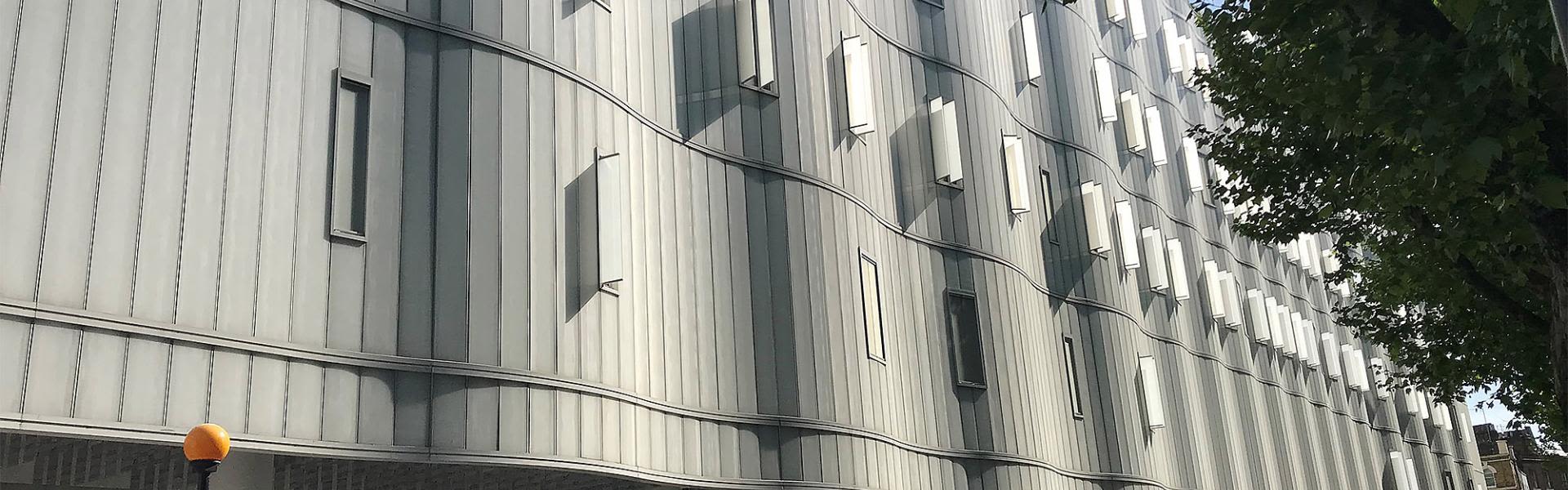
Still today, the Gatsby Unit sits in the heart of the Sainsbury Wellcome Centre (SWC) for Neural Circuits and Behaviour; a purpose-designed, seven-storey building near UCL’s Bloomsbury campus.
Also funded by the Gatsby Charitable Foundation, the SWC fosters a culture of bold research, innovation and collaboration between scientists in 14 interdisciplinary experimental research groups. Within that structure, the central position of the Gatsby Unit connects it directly with experimental laboratory facilities and break-out spaces that facilitate collaboration.
The Unit is also a global training ground for future leaders. It offers an innovative four-year PhD programme in Computational Neuroscience and Machine Learning, and its alumni represent more than 40 countries across six continents. Former members work play leading roles at organisations such as Google DeepMind, Uber, Amazon and Alibaba, while many others continue to shape academia in universities across the UK, Europe, north America and Australasia.
Its role in nurturing talent is reflected in the strong connections Sir Demis maintains with UCL and the deep partnership between the university and Google DeepMind, the support of which creates a range of postgraduate scholarships and research positions such as the Google DeepMind Chair in Machine Learning and Artificial Intelligence at the Centre for AI, and the Google DeepMind Fellow in Sustainable AI.
In its first 30 years, the Gatsby Unit has created and inspired knowledge which now changes lives far beyond Bloomsbury. In particular, the early vision which brought together neurology and machine learning has undoubtedly served to cement the UK’s role as a world-leader what is a rapidly evolving cross-disciplinary field.
And the catalyst? A visionary act of philanthropy.
“[The Gatsby Charitable Foundation gift] has played a key role in the success of the Gatsby Unit,” said Professor Gail Taylor, Dean of UCL’s Faculty of Life Sciences. “This type of funding is particularly significant for universities like UCL because it gives us freedom to think in different ways.
“As we’ve seen with the Nobel Prizes, amazing things happen when space is made for talented people to pursue big ideas.”
 Built with Shorthand